


Ravana is one of the most unforgettable characters in Indian mythology. His ten heads are a symbol known to every person who celebrates Vijayadashami. The idea of Ravana 10 heads creates curiosity even today. Were the heads real? Were they symbolic? Or did they represent his personality?
Ravana was not a one dimensional villain. He was a brilliant scholar, a warrior, a king, a musician, and a devotee of Lord Shiva. The ten heads represent his complex mind and his overflowing powers. Understanding the meaning of Ravana 10 heads helps us understand the deeper messages of the Ramayana.
The Legend Behind Ravana’s Ten Heads
The story of Ravana and his ten heads begins with his intense penance for Lord Brahma. Ravana wanted extraordinary powers and unmatched knowledge. To achieve this, he began a very long and severe meditation.
Ancient texts describe a dramatic moment during his penance. Every time Ravana completed one hundred years of meditation, he offered one of his heads into the sacred fire. He repeated this sacrifice nine times. With each offering, his determination and power grew stronger.
Just before he was about to sacrifice his tenth and final head, Lord Brahma appeared. Pleased with Ravana’s dedication, Brahma restored all ten heads and granted him immense knowledge, strength, and protection.
From that day, Ravana came to be known as Dashamukha and Dashagriva, both meaning the one with ten heads.
Were Ravana’s Ten Heads Real
In traditional Ramayana stories and artwork, Ravana is always shown with ten real heads. Artists use this to highlight his supernatural nature and his role as a powerful ruler of Lanka.
However, many experts today believe that the ten heads also carry a symbolic meaning. They were not just a physical feature but a representation of the different sides of Ravana’s personality. According to philosophical interpretations, the heads reflected ten human emotions and qualities that were all extremely strong within him.
This idea helps us understand Ravana not just as a villain but as a deeply layered character with strengths, weaknesses, brilliance, and flaws.
What Each of Ravana’s Ten Heads Represent
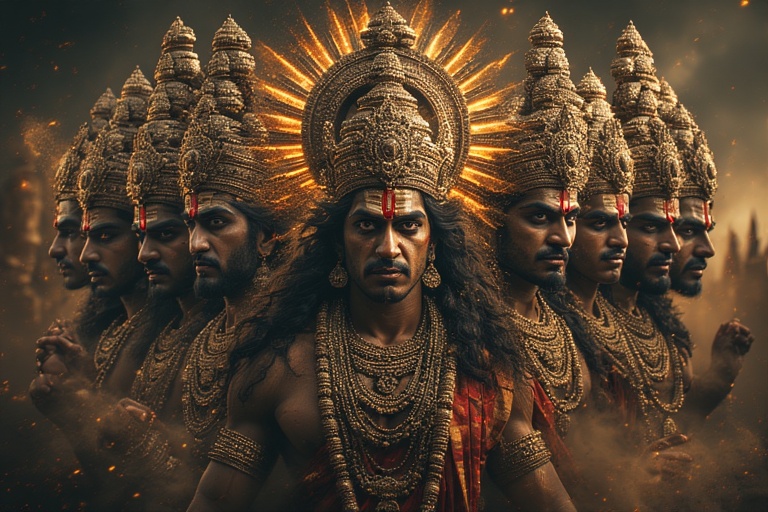
Over the years, scholars created a list of symbolic meanings associated with each head. These meanings show the inner complexity of Ravana and why he sometimes made wise choices and sometimes destructive ones.
Here is the most accepted interpretation:
| Head Number | Represents | Meaning |
|---|---|---|
| 1 | Kama | Desire |
| 2 | Krodha | Anger |
| 3 | Moha | Attachment |
| 4 | Lobha | Greed |
| 5 | Mada | Pride |
| 6 | Matsarya | Jealousy |
| 7 | Buddhi | Intelligence |
| 8 | Manas | Mind |
| 9 | Chitta | Willpower |
| 10 | Ahamkara | Ego |
This table shows that Ravana was a blend of extreme intelligence and extreme emotions. His problem was not a lack of knowledge. His problem was the imbalance between wisdom and ego. His intelligence was sharp, but his desires and pride were stronger.
This imbalance is what eventually led to his downfall.
How Ravana Used His Ten Heads
Ravana’s ten heads played different roles in the stories of the Ramayana. They were not just for show. They helped him think faster, learn deeper, and plan better.
He mastered the four Vedas, the six Shastras, music, Ayurveda, astronomy, and many more fields. Many say that the ten heads symbolize ten types of knowledge Ravana mastered during his life.
In battles, Ravana’s heads also represented his supernatural strength. When Lord Ram cut off one head, it grew back instantly. This made him seem unbeatable, until Ram used the Brahmastra, which finally struck Ravana’s heart.
The heads also show emotional intensity. Ravana loved deeply, fought fiercely, and made decisions quickly. All these qualities made him powerful, but they also caused him to commit mistakes he could not undo.
What the Ten Heads Teach Us Today
The story of Ravana’s ten heads is not just mythology. It carries real life lessons that still matter today.
The ten heads remind us that human beings have a mix of emotions and intelligence. Desire, anger, pride, and ego can easily overpower judgment if not controlled. Ravana was incredibly wise, but his ego was stronger than his wisdom.
This is why Dussehra celebrates not just the victory of Ram over Ravana but also the victory of good qualities over the negative ones inside each of us.
FAQs
-
Do all versions of the Ramayana mention ten heads?
Yes, every major version shows Ravana with ten heads.
-
How were the heads used in battle?
They gave him regenerative power and superhuman thinking abilities.
Conclusion
Ravana 10 heads represent the intense mix of brilliance and flaws inside every human being. Ravana was a genius, a ruler, a devotee, and a warrior, yet his uncontrolled emotions led to his destruction. His story reminds us to balance intelligence with humility and to control ego, desire, and anger.
This is why Ravana remains a central figure in the celebration of Vijayadashami and why his story continues to guide generations.
